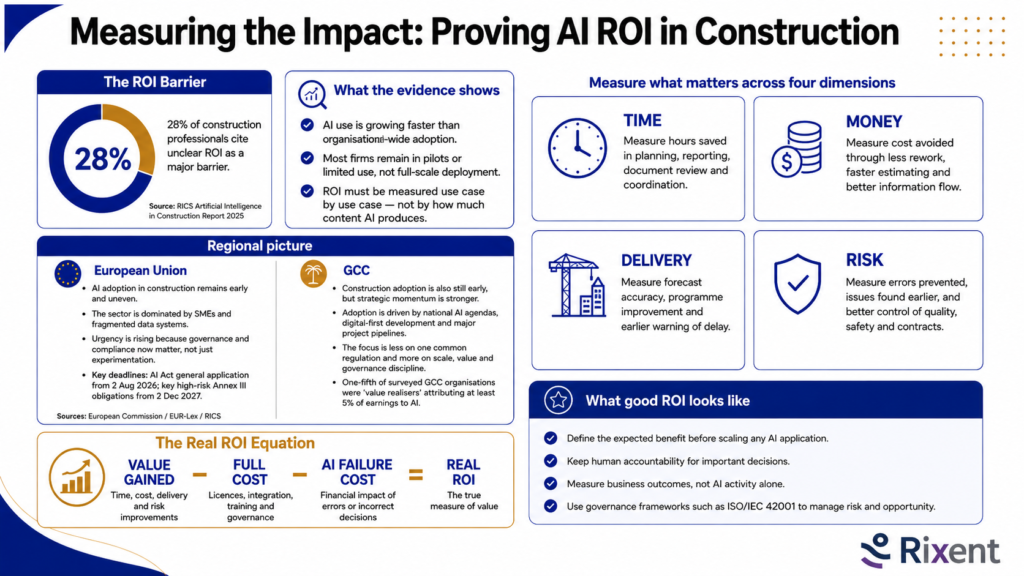
Construction leaders are being asked to invest in AI before the saving is always clear. The question is reasonable. AI adoption should not be justified by enthusiasm, vendor claims or fear of being left behind. It should be justified by measurable reductions in wasted time, duplicated work, reporting effort, rework, delay exposure and decision risk. The business case must show where AI improves delivery capacity and where governance protects the investment.
The saving from AI is rarely one single line item. It comes from many small gains across documents, reporting, scheduling, cost review, risk analysis, tender support and project controls. Boards should ask for a disciplined AI value case: where time is saved, where quality improves, where risk reduces, and how benefits will be measured before wider rollout.
1. Key Judgements
1
AI usage is not the same as AI adoption. Real adoption means approved tools, connected data, clear ownership, checked outputs and measured benefits across live work.
2
The strongest early savings are likely to come from reducing professional time spent on searching, comparing, summarising, reporting and checking project information.
3
Boards should not approve organisation-wide AI rollout until the saving logic, risk controls and benefit measures are clear enough to test.
Linkedin Summary Snippet
Before investing in AI across a construction organisation, the board question is simple: Where is the saving? The answer should not be vague. AI should reduce wasted professional time, improve reporting discipline, support better project controls and help teams see risk earlier. But the value only appears when adoption is governed, measured and connected to real work.
2. What Has Changed
Construction is discussing AI heavily, but scaled adoption remains limited. The source material shows a clear gap between informal AI use and embedded organisational adoption. Many firms are still at no implementation or pilot stage, while only a very small minority report organisation-wide use. This matters because boards are being asked to invest before many organisations have a clear value model.
3. The Real Risk
The risk is that organisations spend money on AI tools without changing how work is done. More licences do not automatically create savings. If data is poor, systems are disconnected and outputs are not checked, AI may add another layer of activity rather than reduce cost. The board needs to know whether AI will save time, reduce rework or improve decisions.
Do not ask, “What can AI do?” Ask, “Which work will it reduce, improve or de-risk, and how will we measure that?”
4. Why This Matters
The pressure to adopt AI is increasing across construction and infrastructure. Productivity is weak, skilled people are stretched, reporting demands are growing and delivery teams handle too much fragmented information. AI can help, but unclear return on investment remains a recognised barrier. That makes a clear, board-level value case essential before scaling.
Board Implication
Boards should not treat AI as a technology purchase alone. They should treat it as an operating change. The investment case should identify where AI will reduce manual effort, improve project information, strengthen controls and free skilled people for judgement-based work. It should also define what must not be automated and where human review remains mandatory.
5. What Needs to Change
Start with a targeted AI value map. Identify 5–8 high-volume activities where skilled staff spend avoidable time: document review, reporting, schedule comparison, cost checks, risk summaries, tender review, meeting actions and lessons learned. Test AI on those activities first. Measure time saved, quality improvement, decision speed, error reduction and user adoption before wider rollout.
Rixent helps boards and delivery organisations test where AI can create measurable value, where controls are needed and how adoption should be governed before scaling.
To provide the best experiences, we use technologies like cookies to store and/or access device information. Consenting to these technologies will allow us to process data such as browsing behaviour or unique IDs on this site. Not consenting or withdrawing consent, may adversely affect certain features and functions.
Functional
Always active
The technical storage or access is strictly necessary for the legitimate purpose of enabling the use of a specific service explicitly requested by the subscriber or user, or for the sole purpose of carrying out the transmission of a communication over an electronic communications network.
Preferences
The technical storage or access is necessary for the legitimate purpose of storing preferences that are not requested by the subscriber or user.
Statistics
The technical storage or access that is used exclusively for statistical purposes.The technical storage or access that is used exclusively for anonymous statistical purposes. Without a subpoena, voluntary compliance on the part of your Internet Service Provider, or additional records from a third party, information stored or retrieved for this purpose alone cannot usually be used to identify you.
Marketing
The technical storage or access is required to create user profiles to send advertising, or to track the user on a website or across several websites for similar marketing purposes.