Building Resilient Investment Pathways in a Changing Middle East

Middle East investment strategies are being tested by regional volatility, trade disruption and shifting investor confidence. The core issue is not whether long-term regional ambition remains valid. It does. The issue is whether funding, delivery and governance models are resilient enough to survive uncertainty. Stronger investment pathways need diversified funding, phased delivery, local supply-chain depth and independent project review.
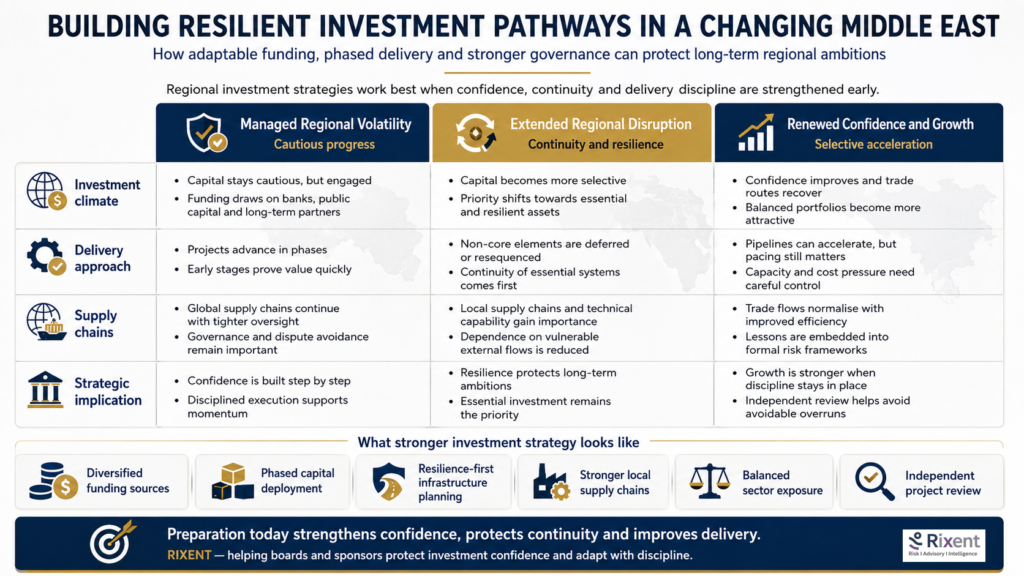
nfographic showing three Middle East investment scenarios and how funding, delivery, supply chains and governance should adapt under regional uncertainty.

The strongest investment strategy is not the fastest one. It is the one that can adapt without losing delivery discipline. Boards and sponsors should test whether their portfolios can continue under three conditions: managed volatility, extended disruption and renewed confidence. Each scenario needs a different funding, delivery and governance response.

1. Key Judgements

1
Capital will not disappear in every scenario, but it will become more selective. Investors will favour projects with stronger governance, clearer phasing and visible delivery control.
2
Mega-projects need phased delivery, not blind acceleration. Early phases should prove value, protect confidence and reduce exposure before full-scale capital is committed.
3
A prolonged high-intensity regional war would shift the issue from investment efficiency to project survival. Critical infrastructure, continuity and resilience would become the priority

2. What Has Changed

The region’s investment model has relied on confidence, global capital, strong logistics and long-term transformation programmes. That model still has strength, but it now faces sharper pressure. Investors are asking harder questions about funding certainty, supply-chain continuity, trade-route risk, project phasing and delivery capacity. This does not mean investment should stop. It means investment pathways must be more adaptable

3. The Real Risk

The real risk is that projects are planned for confidence but not tested for stress. In a contained conflict, the issue may be higher cost, slower funding and cautious investors. In a partial reset, the risk is over-acceleration. In a prolonged regional war, the issue becomes more severe: the physical and economic survival of major projects may be threatened

Before accelerating investment, test whether funding, supply chains, phasing and governance can survive a stressed regional scenario.

4. Why This Matters

Regional investment plans are still moving forward, but the margin for weak planning is narrowing. Funding costs, investor confidence, trade routes, logistics and delivery capacity are all exposed to uncertainty. Sponsors need to know which parts of their portfolios are essential, which are discretionary and which can be phased without damaging long-term ambition

Board Implication

Boards and sponsors should not rely on a single optimistic delivery case. They need scenario-tested investment plans that show what happens under managed volatility, extended disruption and renewed confidence. Each scenario affects capital availability, procurement, supply chains, delivery sequencing and governance pressure differently. Independent review helps avoid avoidable overruns and poor acceleration decisions

5. What Needs to Change

Create a portfolio resilience review before committing to major acceleration. The review should test funding resilience, supply-chain exposure, local delivery capacity, critical infrastructure dependency, cost and schedule pressure, project phasing and independent governance arrangements. This gives boards a clearer view of what can continue, what should be delayed and what needs stronger control

6. How This Works

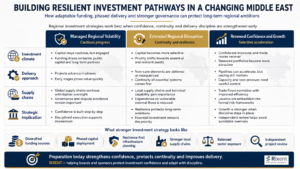
nfographic showing three Middle East investment scenarios and how funding, delivery, supply chains and governance should adapt under regional uncertainty.

Apply This Insight

Request Board Briefing

Contact Us

Share

About the Author

Get future insights like this

Discuss the risk.

Need to test your investment pathway?

Rixent helps boards, sponsors and programme leaders review whether major investment plans are resilient enough for changing regional conditions.

Related Insights