Mega Projects in the Middle East: Why Risk Management Must Move Beyond the Project Register

Mega projects in the Middle East carry high ambition, high investment and high visibility. This insight explains why risk management must move beyond simple project registers and become a board-level discipline linked to delivery, funding and public confidence
Giga project risk middle east

In mega projects, risk management is not administration — it is how leaders protect delivery, investment and trust

1. Key Judgements

1
Mega projects fail less from one single risk and more from unmanaged connections between risks
2
Boards need visibility of the risks that affect delivery, funding, reputation and public confidence
3
Risk management must sit across the whole client organisation, not only inside the project team

Linkedin Summary Snippet

Middle East mega projects are not short of ambition.The real test is whether risk governance keeps pace with scale, speed and complexity.Strong risk management protects delivery, investment and trust

2. Mega-project exposure beyond construction

Middle East mega-projects are closely connected to national infrastructure, tourism, investment and economic diversification. Their scale means that several construction packages, utilities, commercial partners and public commitments must progress together. Project-level risk registers remain useful, but they cannot by themselves reveal exposure across the wider programme.

3. Interdependencies across project risks

Risks become more serious when they interact. A delayed utility connection can hold up commissioning; commissioning delays can reduce revenue; and lost revenue may put pressure on financing or public commitments. If each organisation reports only its own risks, sponsors may see these consequences too late to protect the programme.

If a risk report does not help leaders make a better decision, it is only reporting — not risk management.

4. Programme-wide consequences

A single disruption can affect many contracts, budgets and delivery dates. The board needs to understand these links before decisions become expensive or irreversible. Combined risk reporting can reveal common suppliers, shared infrastructure constraints and emerging pressures on funding or reputation that individual project reports may miss.

Visibility of aggregated risk

Boards should ask what could prevent the overall programme from achieving its intended outcomes, not simply whether each contractor maintains a risk register. That requires a clear view of dependencies, exposure across projects and the decisions that need sponsor intervention. Reports should identify accountable owners, escalation triggers and practical options.

5. Integrated risk ownership and escalation

Give the client organisation one consistent way to identify, compare and escalate material risks across projects. Map shared dependencies, link exposure to cost and programme decisions, assign owners and review the combined position regularly at sponsor and board level.

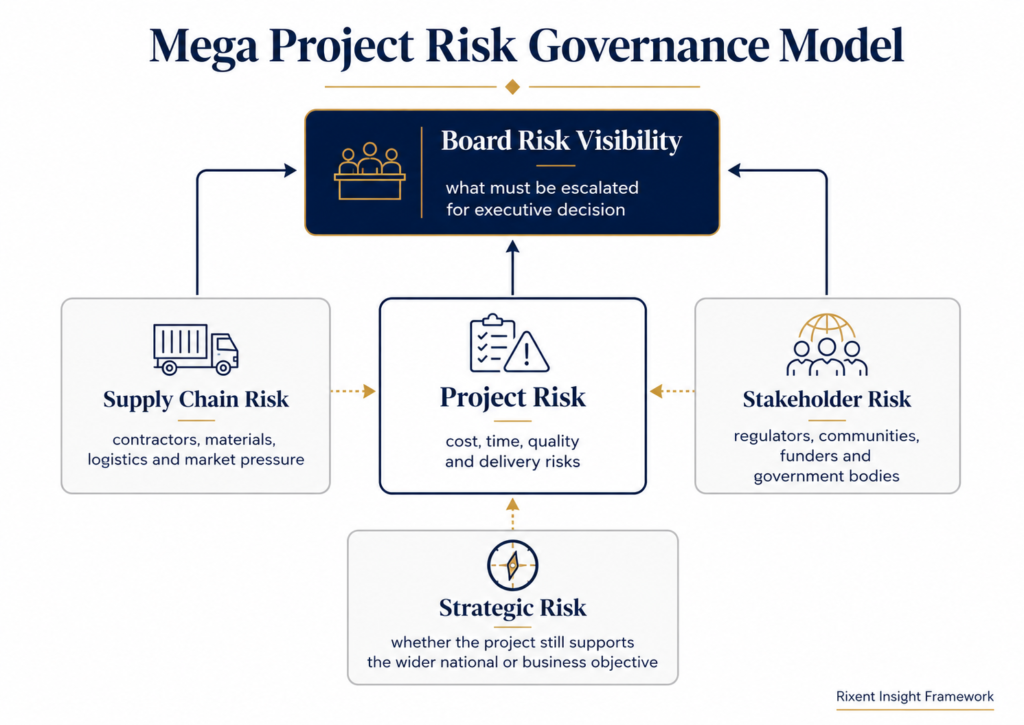
6. Programme risk governance framework

Mega Project Risk Governance Model showing how project risk, supply chain risk, stakeholder risk and strategic risk feed into board risk visibility for executive decision-making.

Apply This Insight

Request Board Briefing

Contact Us

Share

About the Author

Get future insights like this

Download the full briefing

Choose a quick summary or request the full report for deeper tactical-level insight. 

Complete a short form to access full report

https://rixent.com/wp-content/uploads/2026/07/Rixent-Executive-Briefing-–-8-Page-Brochure.pdf

Related Insights