Mega Projects in the Middle East: Why Risk Management Must Move Beyond the Project Register

Mega projects in the Middle East carry high ambition, high investment and high visibility. This insight explains why risk management must move beyond simple project registers and become a board-level discipline linked to delivery, funding and public confidence
Giga project risk middle east

In mega projects, risk management is not administration — it is how leaders protect delivery, investment and trust

1. Key Judgements

1
Mega projects fail less from one single risk and more from unmanaged connections between risks
2
Boards need visibility of the risks that affect delivery, funding, reputation and public confidence
3
Risk management must sit across the whole client organisation, not only inside the project team

Linkedin Summary Snippet

Middle East mega projects are not short of ambition. The real test is whether risk governance keeps pace with scale, speed and complexity. Strong risk management protects delivery, investment and trust

2. What Has Changed

Mega projects in the Middle East are now larger, faster and more strategically important than before. They are no longer just construction schemes. They are linked to national development, tourism, infrastructure, investment and long-term economic transformation. This means risk management must mov

3. The Real Risk

The real risk is not that a project has risks. Every major project does. The real risk is that boards, sponsors and client organisations do not see how those risks connect across cost, time, supply chain, approvals, reputation and funding until it is too late

If a risk report does not help leaders make a better decision, it is only reporting — not risk management.

4. Why This Matters

Mega projects involve many organisations, tight deadlines, large budgets and strong public expectations. A delay, funding problem or supply chain issue can quickly affect confidence in the wider programme. Good risk management helps leaders see problems early, test options and act before issues bec

Board Implication

For boards and sponsors, the key question is not whether the project team has a risk register. A risk register is simply a list of possible problems.

5. What Needs to Change

Risk management needs to move from a project-level activity to an enterprise-level discipline. Enterprise-level means looking across the whole organisation, not just one project. Client organisations should use one consistent risk approach across major programmes, with clear accountability, escalat

6. How This Works

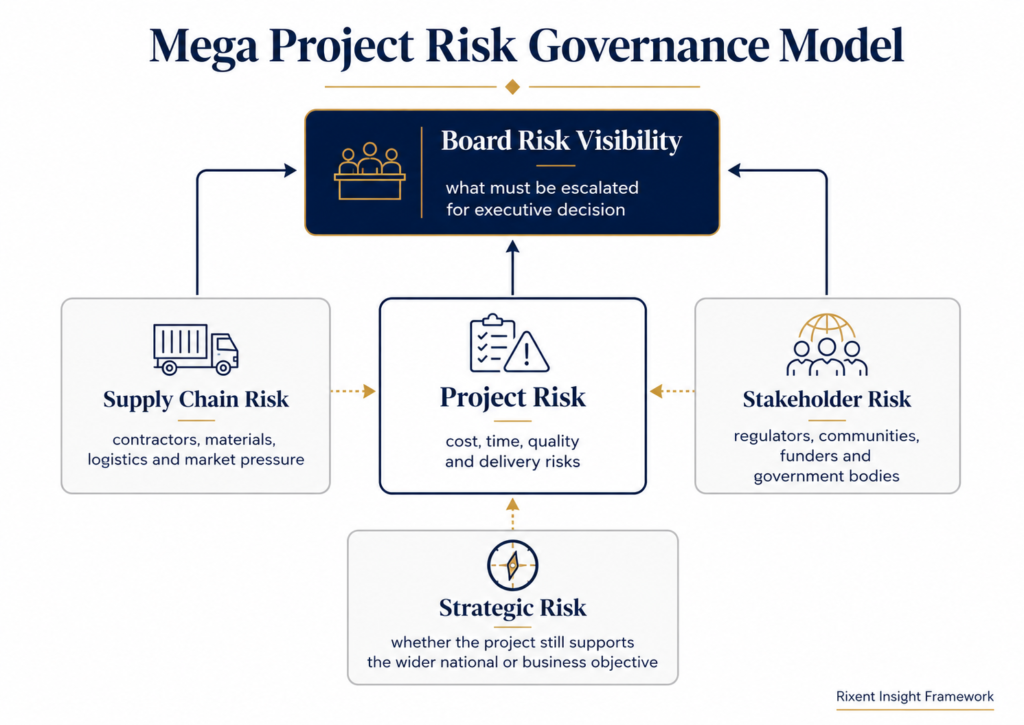
Mega Project Risk Governance Model showing how project risk, supply chain risk, stakeholder risk and strategic risk feed into board risk visibility for executive decision-making.

Apply This Insight

Request Board Briefing

Contact Us

Share

About the Author

Get future insights like this

Discuss the risk.

Need stronger risk visibility across your major programme?

Download PDF versions

Related Insights