Why Most Construction Mega-Projects Get AI Wrong Before They Even Start

Most construction mega-projects do not fail at AI because the technology is weak. They fail earlier—when AI is treated as an innovation pilot rather than a delivery system. Without clear ownership, reliable data, validation and human oversight, a promising tool can scale bad decisions.
Construction leaders reviewing AI-supported project data on a major rail infrastructure site.

1. Key Judgements

1
AI failure usually begins with poor problem definition, not poor software
2
Weak data and unclear accountability can make apparently intelligent outputs unreliable
3
Boards must govern each AI use case according to its decision and delivery riskBoards must govern each AI use case according to its decision

Linkedin Summary Snippet

Construction organisations are adopting AI across planning, estimating, procurement, design and reporting. However, many programmes begin with the technology before resolving data quality, accountability, validation and decision-control risks. This Insight explains why those weaknesses can undermine AI before implementation has properly started.

2. What Has Changed

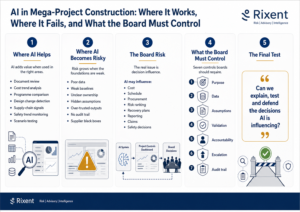
AI is moving from isolated experiments into estimating, design review, scheduling, procurement, safety, document control, risk reporting and claims. Outputs may now influence cost, time, contracts and safety before organisations have agreed how those outputs will be checked.

3. The Real Risk

The core risk is not the algorithm alone. It is the delivery system around it: unclear purpose, incomplete or biased data, hidden assumptions, weak testing, poor integration, unapproved tools and no named decision owner. At scale, these weaknesses can spread across the programme.

Treat every AI use case as a project decision tool. Define who owns the input, who checks the output, what evidence is retained and when a human must override it.

4. Why This Matters

Teams are using generative AI, supplier tools and embedded software faster than governance is being established. This creates Shadow AI, inconsistent controls and decisions that may be difficult to explain later—especially when challenged by clients, auditors, regulators or in a dispute.

Board Implication

Boards may approve the investment but still carry accountability for decisions no one can explain, validate or trace.

5. What Needs to Change

Start with the decision, not the tool. Classify each use case by consequence; confirm data readiness; assign an accountable owner; set accuracy and human-review thresholds; pilot under real conditions; keep an audit trail; and obtain independent assurance before scaling.

6. How This Works

Construction leaders reviewing AI-supported project data on a major rail infrastructure site.

Apply This Insight

Request Board Briefing

Contact Us

Share